Scope Creep: How Projects Die in Silence
The meeting started at 2 PM. By 2:15, your 8-week project became a 12-week project. Nobody called it out. Nobody documented it. It just... happened.
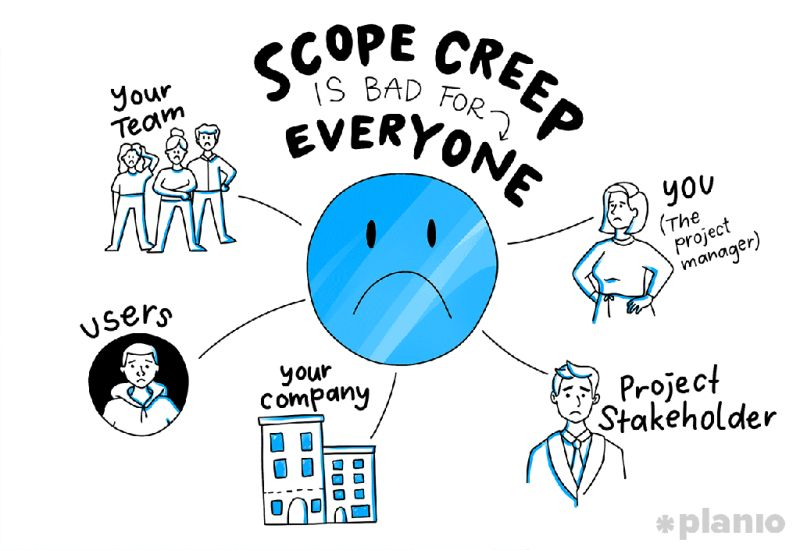
Scope creep impacts every single stakeholder. Illustration: Planio.
A stakeholder casually mentioned: "What if we also built mobile?"
The product manager nodded: "That would be nice."
The CEO didn't say no.
And just like that, the project's work started to grow beyond what was originally agreed upon. This is scope creep. It doesn't arrive with a bang. It arrives in whispers.
The Hidden Tax of "Yes"
Early in my career, I thought being a good leader meant saying yes to everything.
More features? Sure. Different direction? Absolutely. Can we pivot mid-project? Why not. The customer asked? Let's do it. The stakeholder suggested it? We can squeeze it in. The team wanted to add something cool? Sure, why not.
I was being flexible. Or so I thought.
Here's what actually happened: a supposed 8-week project turned into 6 months. The team was exhausted. The budget ballooned. The quality suffered. And worst of all, the customer was disappointed because we delivered late and didn't deliver what they originally wanted.
I wasn't being flexible. I was being reckless.
What I didn't realize was that saying "yes" to everything is actually saying:
I was confusing flexibility with lack of boundaries. They're not the same thing.
The brutal truth: 52% of projects experience scope creep... if you want to control your timeline and budget, controlling scope is non-negotiable.
The Mechanism: Why This Happens
Here's what I discovered: scope creep doesn't happen because stakeholders are unreasonable. It happens because we never defined what we were actually building in the first place.
Vague requirements. Handwavy agreements. "We'll figure it out as we go." This is an invitation to scope creep.
And the moment you say "yes" to an undefined feature, you've already lost.
You cannot manage what you haven't defined.
I started treating scope like I treat database architecture: with precision. No ambiguity. No assumptions. No "later."
Later never comes.
The 5-Point Defense System
1. Define Requirements Like a Contract
Before a single line of code is written, sit with stakeholders. Get specific. Not vague. Specific.
You're writing a contract. Every word matters.
I create a Requirements Document during initiation. Every stakeholder reads it. Every stakeholder signs off on it. This becomes your north star.
Why this works: Vague requirements are an open door. Specific requirements are a contract. When someone asks for something new, you pull it out. If it isn't documented, it doesn't exist.
2. The "Out of Scope" Shield
Most projects fail because they never define what they're NOT doing. In your project charter, be explicit:
OUT OF SCOPE (PHASE 1):
❌ Mobile app (Phase 2)
❌ Custom reporting beyond templates
❌ Integration with X system (separate project)
❌ Performance optimization for 100k+ concurrent users
❌ Multi-language support
Pin this list. Reference it every single time a new request comes in.
When a stakeholder proposes something: "That's on our out-of-scope list for Phase 1. Here's how we handle Phase 2..." No debate. No emotion. Just the boundary you all agreed to.
3. Implement a Change Control Process
Here's where most teams fail: they have no process for handling changes.
So when change requests come in (and they will), people improvise. Someone pushes. Someone yields. Work gets done that wasn't planned. Timelines slip silently. I implemented a formal change control process. 30 minutes per request. Saves weeks of chaos.
4. The Art of Negotiation (Offer Options, Not "No")
How do you tell a C-level executive or key customer "no" without creating conflict? You don't say "no." You present trade-offs.
Instead of: "No, we can't do that." Try: "Here's what saying yes would cost us. Which matters more?"
Real Example:
Executive: "Can we add advanced analytics to the launch?"
Me: "Analytics requires a dedicated data engineer for 4 weeks. Here
are your options:
- Option A: Launch on time (June). Add analytics in Phase 2 (September).
- Option B: Build lite analytics (2 weeks) covering 80% of use cases. Launch in July.
- Option C: Push launch to August. Include full analytics.
Which matters more—hitting Q2 or having analytics day one?"
The executive chose Q2. Problem solved. No conflict.
5. Document the "Hidden" Costs
Some scope creep is inevitable. You cannot prevent it entirely. But you can manage it.
Every piece of unplanned work gets logged: What was it? Why was it necessary? How much effort? What was the cost?
This creates visibility. It prevents the same mistakes next project. You're not silently absorbing work that should be billed or tracked.
The Real Insight
Being a Tech Lead isn't about doing everything. It's about doing the right things well. Protecting your team's capacity. Delivering on commitments.
Scope creep doesn't happen because your team is lazy or incompetent.
Scope creep happens because someone didn't draw a line in the sand early enough. And that someone is you.
You get to choose: Will you be the leader who says "yes" to everything and delivers chaos? Or the leader who says "yes" strategically, protects boundaries, and delivers wins?
Draw your line. Know what you're carrying. Deliver with confidence. 🗺️
Data & Sources
- PMI Pulse of the Profession 2024/2025: Project Management Institute's research showing 52% of projects experience scope creep, and only 31% of projects successfully meet all three criteria (on-time, on-budget, on-scope).
- Project Success Metrics: PMI data on scope creep causes, including unclear objectives (37% of failures), communication breakdowns (57% of failing projects), and poor change management processes.
If this was useful, let's connect. I write about engineering leadership, backend architecture, and lessons from building products at scale.
Follow on LinkedIn